Certified Payroll vs Prevailing Wage: How They Differ and Connect
Short answer
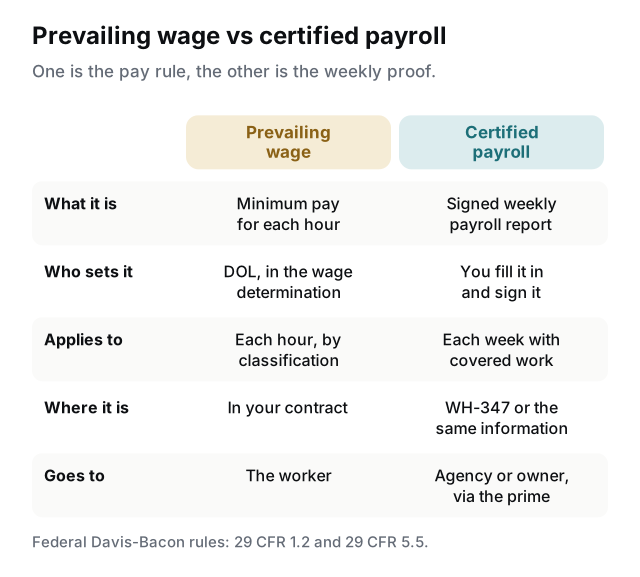
They are two halves of the same obligation. Prevailing wage is the minimum hourly pay, a basic rate plus fringe benefits, that the wage determination in your contract sets for each type of work. Certified payroll is the signed weekly report you submit to show you paid it. One is the rule; the other is the proof.
The difference at a glance
A job with federal money and the Davis-Bacon labor clauses brings both at once, which is why they get mixed up. They answer different questions: how much do I owe each hour? and how do I show I paid it?
What prevailing wage means
The Davis-Bacon Act covers federally funded or assisted contracts over $2,000 to build, alter or repair public buildings and public works. Laborers and mechanics on those jobs must get at least the locally prevailing wages and fringe benefits. DOL publishes the rates as wage determinations on SAM.gov: one line per classification, each with a basic hourly rate and a fringe rate.
Under 29 CFR 1.2, the prevailing wage for a classification is the rate paid to more than 50% of workers on similar projects in the area. With no majority, it's the rate paid to the largest group, if that group is at least 30%. Failing that, it's a weighted average.
DOL's resource book says a wage determination typically sets "the minimum wage rates and fringe benefits which must be paid for the entire term of the contract." You can pay more, in any mix of cash and fringe (see our fringe benefits guide). Because rates are set per classification and county, there's no single prevailing wage for a whole state.
What certified payroll is
Under 29 CFR 5.5(a)(3), every contractor and subcontractor submits a payroll for each week with covered work. It lists each worker with an identifying number (never the full Social Security number), classification, hourly rates, daily and weekly hours, deductions and wages paid. DOL's resource book says it's due within 7 days after the regular pay date.
The "certified" part is the signed Statement of Compliance. On the WH-347 it's box 1 on page 2, where you certify the rates paid are "not less than the applicable wage and fringe benefits rates" in the wage determination. False statements fall under 18 U.S.C. § 1001: a fine, up to 5 years in prison, or both.

DOL calls the WH-347 itself optional: any format with the same information and a signed statement works unless your contract says otherwise. The prime contractor is responsible for submitting every sub's payroll, and records are kept for 3 years after all work on the prime contract is done. For each box, see how to fill out the WH-347.
How they connect: one week, start to finish
Say the wage determination lists electricians at $47.50 basic plus $26.13 fringe. One electrician works 40 hours. You pay $47.50 cash and contribute $26.13 an hour to health and pension plans.
- The prevailing wage test: $47.50 + $26.13 = $73.63, exactly the required rate.
- The payroll entry: 40 hours, $47.50 in column 6A, $1,045.20 fringe credit in 6B (40 × $26.13) and $1,900.00 gross in 7A (40 × $47.50).
- The statement: you sign that the rates paid weren't below the wage determination.
Had you paid $45.00 cash, the payroll would show the gap plainly: $2.50 an hour, $100.00 owed for the week. Certified payroll doesn't make you compliant; it makes compliance visible. The prevailing wage calculator runs this check, overtime included.
Prevailing wages vs union wages
A union wage is the rate in a collective bargaining agreement. A prevailing wage is whatever DOL finds is paid in the area under the 50% and 30% tests above. Where union rates win that test, the prevailing wage is the union rate; where they don't, it isn't. Each wage determination tells you which by the identifier above each group of rates:
| Identifier | What the rate is based on |
|---|---|
| A union code: four letters plus a number | A union rate found prevailing. The letters name the union, the number is the local. |
| UAVG | A weighted average of union rates, where all the data was union but no single rate prevailed. |
| SU | Survey data, usually a weighted average of union and non-union rates. |
| SA | Rates adopted from a state or local prevailing wage survey that meets DOL's criteria. |
You don't have to be a union shop to work a job with union-based rates. You do have to pay at least those rates, in cash or fringe, for every hour of that classification.
Salaried workers and other edge cases
- Salaried crew. 29 CFR 5.5(a)(1) requires the wage determination rates regardless of any contractual relationship with the worker. Each week's salary still has to cover the hours worked at those rates.
- Foremen and supervisors. Bona fide executive, administrative and professional employees aren't covered, but a working foreperson who spends more than 20% of a week on trade work is covered for that time (29 CFR 5.2).
- Weeks with no work. The federal rule only requires a payroll for weeks with covered work, but some agencies and primes still want a no-work payroll.
- Two classifications. A worker who does two kinds of work in a week is owed each classification's rate for the hours in it, on a separate payroll row. DOL's instructions say that without an accurate split, every hour is owed at the highest applicable rate.
California public works
Many states have their own prevailing wage laws and payroll systems for state and local projects. In California, according to the Department of Industrial Relations (DIR):
- Public works projects over $1,000 must pay the prevailing wage DIR determines and keep payroll records.
- Contractors and subcontractors submit certified payroll records directly to the Labor Commissioner through DIR's electronic system, at least monthly or more often if the contract requires.
- Contractors must register with DIR ($400 per fiscal year, July 1 to June 30) before bidding on or working on public works.
- Projects up to $25,000 for construction or $15,000 for maintenance are exempt from electronic reporting and registration, but payroll records must still be kept and produced on request.
If a California job also has federal money, ask the awarding body which rates and reporting apply.
The federal contractor minimum wage in 2026
This is a third, separate floor. Executive Order 13658 sets a minimum wage for workers on certain federal contracts, including Davis-Bacon contracts, awarded between January 1, 2015 and January 29, 2022 and not renewed or extended since. A Federal Register notice of February 9, 2026 raised it to $13.65 an hour from May 11, 2026, with a $9.55 cash wage for tipped workers.
The higher Executive Order 14026 rate for newer contracts no longer applies: it was revoked on March 14, 2025 by Executive Order 14236, and DOL says it is no longer enforcing it. DOL's resource book notes that an Executive Order minimum can apply in addition to the rates in the wage determination, so check whether your contract is one of the older ones it covers.
Let the tool do the weekly part
The prevailing wage check and the certified payroll can come from the same data. Certified Payroll for Google Sheets keeps your wage determination rates, workers and hours in a sheet, checks each worker's pay against the basic rate plus fringe (overtime included), and fills in the official WH-347 PDF for each project and week. It doesn't look up wage determinations for you, run paychecks or submit to California's DIR system. For one project a week, the free WH-347 template may be enough.
General information, not legal or payroll advice. Your contract's wage determination, the regulations and the agency's instructions are the authority, and you're responsible for each certified payroll you sign. For a specific situation, ask the agency's labor compliance officer or a construction attorney.
Sources
- 29 CFR 1.2: definition of prevailing wage
- 29 CFR 5.5: payroll records and weekly certified payrolls
- DOL Wage and Hour Division: instructions for completing Form WH-347
- DOL Prevailing Wage Resource Book: Davis-Bacon wage determinations
- DOL Prevailing Wage Resource Book: Davis-Bacon compliance principles
- Federal Register, February 9, 2026: Executive Order 13658 minimum wage rate change
- California DIR: public works registration and reporting FAQ
Frequently asked questions
What exactly is certified payroll?+
A weekly payroll report for a federally funded or assisted construction job, listing each worker's classification, hours, rates, deductions and pay, with a signed Statement of Compliance. DOL's Form WH-347 is the optional standard format.
Is certified payroll the same as prevailing wage?+
No. Prevailing wage is the minimum rate you must pay for each hour of covered work. Certified payroll is the weekly signed report that shows what you actually paid, so the agency can check it against that minimum.
What is the difference between prevailing wages and union wages?+
A union wage is whatever a collective bargaining agreement sets. A prevailing wage is the rate DOL finds is paid in the area, which is the union rate for some classifications and a survey-based rate for others. The wage determination's rate identifiers show which.
What is the minimum wage for federal contractors in 2026?+
For contracts still covered by Executive Order 13658, it's $13.65 an hour from May 11, 2026, and $9.55 cash wage for tipped workers. DOL no longer enforces the higher Executive Order 14026 rate, which was revoked in March 2025.
Does the subcontractor or the prime submit certified payroll?+
Every contractor and subcontractor with workers on the job prepares and signs its own. Under the federal rule the prime is responsible for getting all of them to the agency, so subs usually send theirs to the prime.