Davis-Bacon Fringe Benefits: What Counts and How Credit Works
Short answer
On a Davis-Bacon job, the wage determination lists a basic hourly rate and a fringe benefit rate for each classification, and every hour worked must be paid at least the two added together. You can meet the fringe part with contributions to bona fide benefit plans (health, pension, vacation and similar), with cash in lieu of benefits, or with a mix. Plan credit is usually annualized over all hours worked, and unfunded plans need DOL approval first.
How Davis-Bacon fringe benefits work
The Davis-Bacon Act defines the prevailing wage as two parts. The basic hourly rate is the cash paid directly to the worker. The fringe benefit rate is what an employer contributes to, or spends on, benefits for each hour. A wage determination lists both for every classification. DOL's illustration in 29 CFR 5.31 is a common laborer at a $21.93 basic rate plus $6.27 in fringe benefits.
Your obligation is the total. For that laborer it's $28.60 for every hour on the project. The fringe part is not optional: if you don't provide a worker benefits worth $6.27 an hour, you pay the difference as cash.
Where benefits don't prevail in an area, the wage determination shows only a basic rate (29 CFR 5.30(b)). Each classification stands alone, with its own fringe for the hours worked in it. For how these rates differ from the weekly report that proves you paid them, see certified payroll vs prevailing wage.
What counts as a bona fide fringe benefit
The act lists the benefits Congress saw as common in construction, plus an open-ended "other bona fide fringe benefits". The test that trips contractors up is the last clause of 29 CFR 5.29(a): credit is only allowed where the benefit isn't already required by federal, state or local law.
| Usually creditable | Not creditable |
|---|---|
| Medical or hospital care, or insurance for it | Workers' compensation, unemployment compensation, Social Security and other benefits required by law |
| Pensions on retirement or death | Travel, subsistence and industry promotion funds (normally) |
| Life, disability, sickness and accident insurance | Your own costs of running the benefits: processing claim forms, paying carrier invoices, compliance recordkeeping |
| Vacation and holiday pay | Use of a company truck |
| Unemployment benefits beyond what the law requires, and costs of registered apprenticeship programs | Gifts and bonuses: DOL's example is a Thanksgiving turkey or a Christmas bonus |
A benefit on the left still has to be bona fide: contributions paid irrevocably to a trustee or third party (29 CFR 5.26), or an enforceable commitment to a financially responsible plan, communicated to workers in writing (29 CFR 5.23). If unsure, ask the Wage and Hour Division before claiming it.
Plans, cash in lieu or a mix
29 CFR 5.31 gives three ways to meet the $21.93 + $6.27 laborer rate:
- Plans. Pay at least $21.93 cash and contribute at least $6.27 an hour to bona fide plans.
- Cash in lieu. Pay $21.93 plus $6.27 in cash instead of benefits: $28.60 an hour.
- A mix. Say $3.00 an hour in health credit and $3.27 cash in lieu, or any split where cash and benefits total at least $28.60.
DOL's resource book adds that no other method of payment is recognized, and that cash above the basic rate can make up for low plan credit, and the reverse, as long as the total holds. The prevailing wage calculator runs that test for one worker's week.
Funded and unfunded plans
A funded plan is one you pay into: an insurance carrier, a union trust fund, a 401(k). Under 29 CFR 5.26, contributions must be irrevocable, the trustee or third party can't be affiliated with you, and the fund can't let you take the money back. Conventional plans like these don't need DOL's approval (29 CFR 5.29(d)).
An unfunded plan pays benefits from your own general assets, the usual case for a company vacation or sick leave policy. Under 29 CFR 5.28 it only counts if it:
- could reasonably be expected to provide the benefits;
- is a legally enforceable commitment;
- is carried out under a financially responsible plan;
- has been communicated in writing to the workers it covers; and
- has been approved by DOL. Requests go by email to
unfunded@dol.govor by mail to WHD's Division of Government Contracts Enforcement.
Until approval comes through, pay that part of the fringe as cash in lieu or into a funded plan.
Annualization: turning a plan cost into an hourly credit
You can't take your whole contribution for a worker and spread it over Davis-Bacon hours only. Under 29 CFR 5.25(c), you divide the plan's cost by all the hours the worker worked in the period it covers, on private jobs as well as covered ones. That's the hourly credit you can claim. Section 5.25 was last amended by DOL's 2023 Davis-Bacon rule, which took effect October 23, 2023.
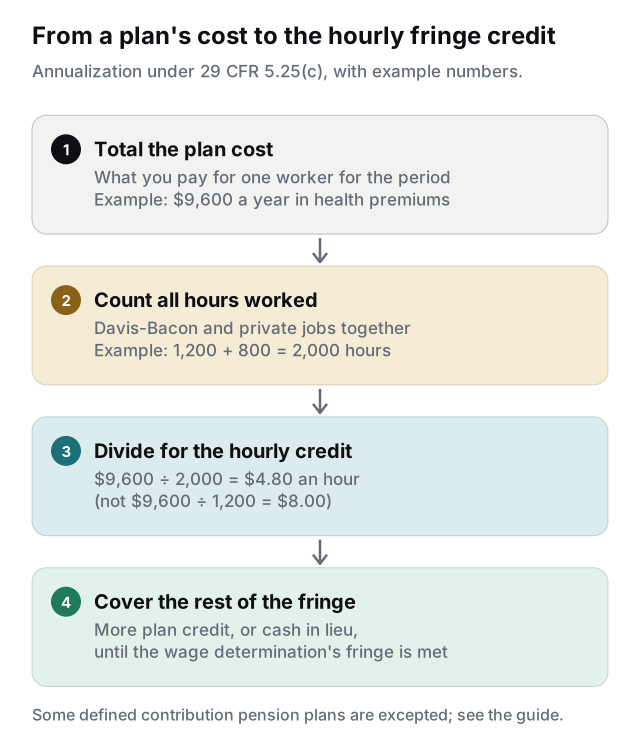
Claiming $8.00 would overstate the credit by $3.20 an hour, and that gap is wages owed. Against a $6.27 fringe, $4.80 leaves $1.47 an hour to pay another way. Figure each worker's credit separately when contributions differ.
There are two ways out of annualizing:
- Defined contribution pension plans are excepted without a request if they provide immediate participation and essentially immediate vesting, meaning within the first 500 hours, and they meet the two tests below.
- Other plans can get an exception by writing to
DBAannualization@dol.gov. It is granted only if the benefit isn't continuous through the year and doesn't pay for both private and covered work.
Apprentices and administrative costs
Apprentices get fringe as their registered program says. If the program is silent, DOL's resource book says they're owed the full fringe amount on the wage determination. Separately, you can take credit for what you spend on a registered program (instruction, books, tools) under 29 CFR 5.29(g), but only against the same classification, and annualized over the hours of all workers in that classification.
Administrative costs split two ways under 29 CFR 5.33. Premiums to an insurer, contributions to a trust fund, and fees to a third-party administrator for running and delivering benefits are creditable. Your own office work on benefits is not, even if you pay someone else to do it.
Fringe on overtime hours
Fringe is owed for every hour, overtime included, but at the straight amount. 29 CFR 5.32 leaves fringe contributions and cash paid in lieu of fringe out of the rate the overtime premium is based on, though that rate can't fall below the basic rate. In the regulation's example, $3.50 cash paid on a $3.00 + $0.50 determination, with the $0.50 in lieu of benefits, means overtime is figured on $3.00.
Where fringe goes on the WH-347
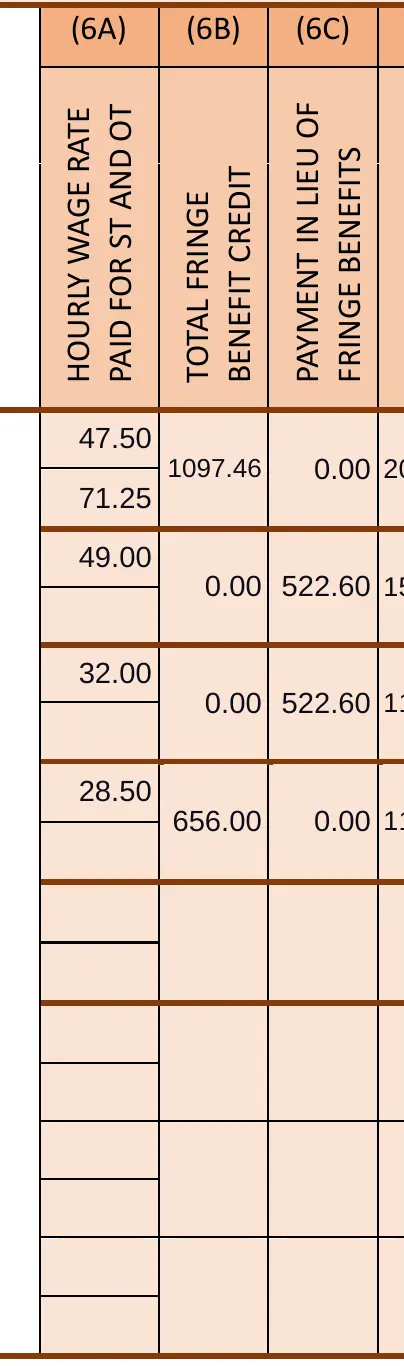
On page 1, column 6A is the cash rate paid, without any cash in lieu. Column 6B is the week's plan credit: total hours times the worker's hourly credit. Column 6C is cash paid in lieu of fringe for the week.
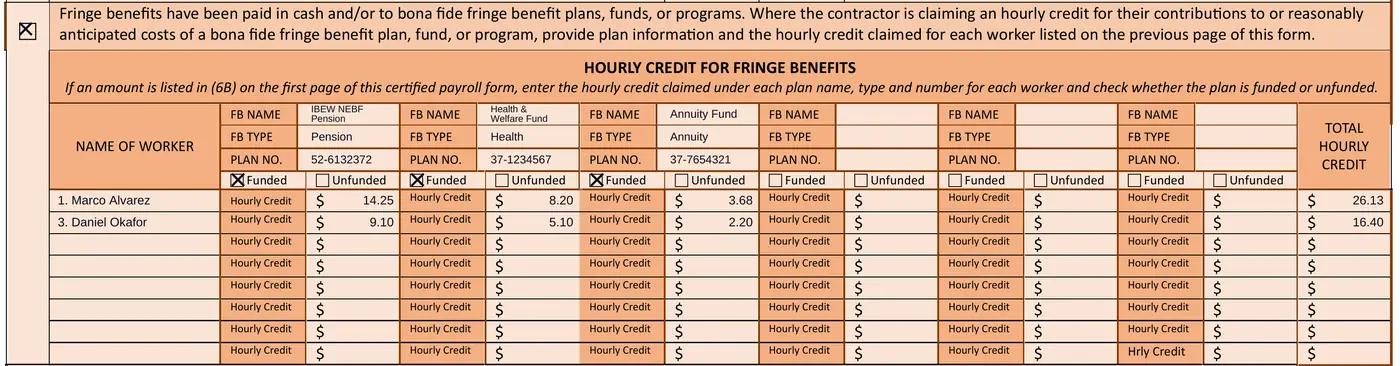
On page 2, tick box 5 whenever fringe was paid. For plan credit, fill in each plan's name, type, number, funded or unfunded, and each worker's hourly credit. For cash in lieu only, tick the box and leave the table blank.
The WH-347 guide covers the rest of the form box by box.
Let the sheet do the arithmetic
Certified Payroll for Google Sheets keeps up to six fringe plans and each worker's hourly credits and cash in lieu, checks that cash plus credits cover the basic rate plus fringe, and fills in 6B, 6C and the page 2 plan table on the official PDF. It doesn't annualize for you or decide whether a plan is bona fide: you enter the hourly credit you've already worked out.
General information, not legal, tax or payroll advice. The wage determination in your contract, 29 CFR part 5 and DOL's Wage and Hour Division are the authority. For a specific plan or situation, ask WHD or a construction attorney.
Sources
- 29 CFR part 5, subpart B: interpretation of the Davis-Bacon fringe benefits provisions (5.20–5.33)
- DOL Prevailing Wage Resource Book: Davis-Bacon compliance principles
- DOL: instructions for completing Form WH-347
- 26 U.S.C. 132: certain fringe benefits (tax code)
- NASBP: how the 2023 Davis-Bacon rule sets new hurdles for fringe benefit credit
Frequently asked questions
How do fringe benefits work on a Davis-Bacon job?+
The wage determination sets an hourly fringe amount on top of the basic rate. For every hour worked you owe at least that amount, as bona fide plan contributions, cash in lieu of benefits, or a mix.
Can I pay Davis-Bacon fringe benefits in cash?+
Yes. 29 CFR 5.31 lets you pay the whole fringe amount as cash in lieu of benefits. It goes in column 6C of the WH-347, not in the hourly rate, and it's left out of the rate used to work out overtime.
Does paid time off count toward the fringe?+
Vacation pay is one of the benefits the act lists. If you pay it from company funds rather than into a trust or insurance plan, it's an unfunded plan, so you need DOL approval before you take credit for it, and the credit has to be annualized.
Are fringe benefits owed on overtime hours?+
Yes. The fringe amount is owed for every hour worked, overtime included, but it isn't multiplied. The overtime premium is figured on the cash rate, never less than the basic rate.
Are these the fringe benefits defined under 26 U.S. Code 132?+
No. Section 132 of the tax code lists fringe benefits that employees can leave out of taxable income, such as de minimis and working condition fringes. Davis-Bacon fringe is part of the prevailing wage under 40 U.S.C. 3141 and 29 CFR part 5.