Davis-Bacon Prevailing Wage Calculator: Fringe and Overtime
Pay check · one worker, one classification, one week
$4.00
Estimated owed to this worker for the week.
Every hour
Owed $55.00 ($34.00 + $21.00 fringe), paid $55.00.
Overtime
Cash rate needs $49.00: the full amount plus half of $34.00. Paid $48.00.
Cash is below the $34.00 basic rate. That's allowed because fringe covers the difference, but the overtime premium is still half of $34.00.
WH-347 entries for this classification
- 5Total hours
- 44
- 6BFringe credit
- $1,012.00
- 6CCash in lieu
- $0.00
- 7AGross pay
- $1,472.00
Short answer
Every hour on a Davis-Bacon job has to be paid at least the wage determination's basic rate plus fringe, in any mix of cash, plan contributions and cash in lieu of fringe. Each overtime hour is owed that amount plus half the basic rate, or half the cash rate if you pay more. The calculator above checks both and shows what's owed.
The rules it checks
| Rule | What it means |
|---|---|
| Every hour is paid basic + fringe | Cash rate + hourly plan credit + cash in lieu must be at least the basic hourly rate plus the fringe rate in the wage determination, for the classification of work done. |
| Any mix counts | Cash above the basic rate counts toward fringe, and fringe above the fringe rate counts toward the basic rate. Only the total is tested. |
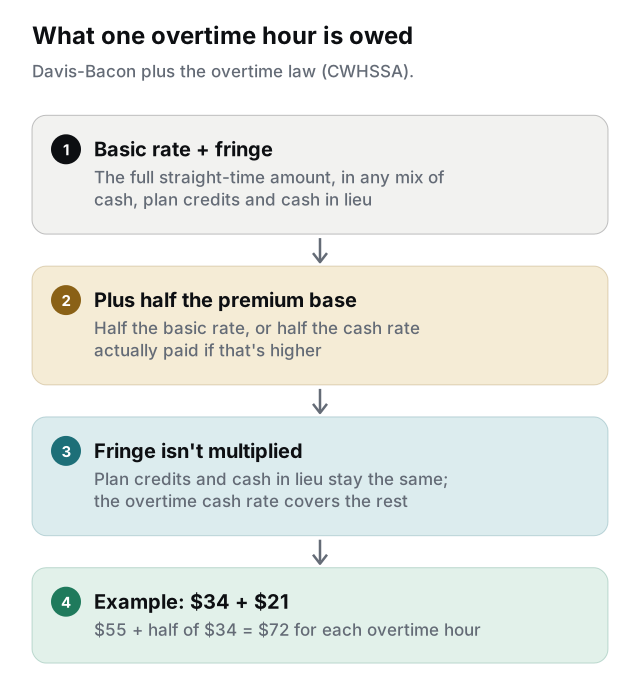
| Overtime adds half | Each overtime hour is owed the full hourly amount plus half the basic rate, or half the cash rate if you pay more than the basic rate. Fringe isn't multiplied. |
Each classification stands alone. A worker who did two kinds of work in a week needs a check for each, at each classification's rates.
Paying fringe: plans, cash or both
The regulations at 29 CFR 5.31 let you meet the prevailing wage by paying cash, by contributing to bona fide fringe benefit plans (pension, health, vacation and the like), or by a combination. DOL's resource book gives three ways to meet a wage determination of $34.00 basic plus $21.00 fringe:
- $55.00 an hour in cash;
- $34.00 cash plus $21.00 in pension or other bona fide benefits;
- $32.00 cash plus $23.00 in benefits.
The hourly credit for a plan is usually not just this week's contribution divided by this week's hours. Under 29 CFR 5.25(c), contributions must be annualized: divided by all hours the worker worked in the period, on private jobs as well as Davis-Bacon ones. Some defined contribution pension plans with immediate vesting are excepted. Enter the annualized hourly figure as the plan credit.
Overtime on Davis-Bacon jobs
On contracts covered by the Contract Work Hours and Safety Standards Act, hours over 40 in a workweek are overtime. Fringe is owed for those hours too, but 29 CFR 5.32 leaves fringe contributions and cash paid in lieu of fringe out of the rate the premium is figured on. That rate is the cash rate actually paid, and never less than the basic rate in the wage determination.
DOL's example: an electrician works 44 hours under a $27.00 + $18.00 wage determination. The worker is owed 44 × $45.00 = $1,980.00 plus 4 × 0.5 × $27.00 = $54.00, a total of $2,034.00.
Three worked examples
All three use the $34.00 + $21.00 wage determination, 40 straight-time hours and 4 overtime hours.
- Cash only. You pay $55.00 an hour with nothing to plans. Enter $34.00 as the cash rate and $21.00 as cash in lieu of fringe, since that part is paid instead of benefits. Overtime must be at least $34.00 + $17.00 = $51.00 cash plus the $21.00, so $72.00 an hour, as in DOL's example.
- Cash below the basic rate. $32.00 cash plus $23.00 pension covers every straight-time hour. Paying overtime at 1.5 × $32.00 = $48.00 falls $1.00 short, because the premium is half of the $34.00 basic rate: $55.00 + $17.00 − $23.00 = $49.00. Four overtime hours means $4.00 owed. This is the calculator's starting example.
- Fringe short. $34.00 cash plus $18.00 pension is $52.00, $3.00 short every hour: $120.00 on 40 straight-time hours, plus the same $3.00 on each overtime hour.
From the result to your WH-347
The figures under the result are the worker's entries on page 1 of the WH-347 for this classification: total hours (5), fringe benefit credit (6B), cash in lieu of fringe (6C) and gross pay on the project (7A). The cash rate and overtime rate go in 6A, and each plan's hourly credit goes in the fringe table on page 2. The WH-347 guide explains every box, and the free template does the arithmetic for a whole crew.
What it doesn't cover
- Apprentices. Their rate is a percentage of the basic rate set by the registered program for their level. Enter those rates instead of the journeyworker's.
- Whether overtime rules apply. Not every contract is covered by the Contract Work Hours and Safety Standards Act; your contract's labor clauses say so.
- State prevailing wage laws. States set their own rates and sometimes their own overtime and fringe rules. This checks the federal Davis-Bacon rules only.
- Whether a plan is bona fide, or whether an unfunded plan has DOL's approval. Credit only counts for plans that qualify.
Running payroll for a crew on several projects? Certified Payroll for Google Sheets runs these checks for every worker and classification each week, then fills in the official WH-347 PDF.
General information, not legal or payroll advice. The wage determination in your contract, the regulations and DOL's guidance are the authority, and the result is an estimate based on what you enter.
Sources
Frequently asked questions
Can I pay the fringe benefits as cash?+
Yes. Under 29 CFR 5.31 the fringe can be paid as contributions to bona fide plans, as cash, or a mix. Cash paid instead of fringe goes in column 6C of the WH-347, not in the hourly rate.
Can extra fringe make up a cash rate below the basic rate?+
Yes. DOL's Prevailing Wage Resource Book says cash above the basic rate can offset fringe, and vice versa: $32 cash plus $23 in pension meets a $34 + $21 wage determination. Overtime is still figured on the $34 basic rate.
Are fringe benefits owed on overtime hours?+
Yes, for every hour worked, but they aren't multiplied. The overtime premium is half the basic rate, or half the cash rate if you pay more than the basic rate.
Does it work for apprentices?+
Only if you enter the apprentice's rates. Registered apprentices are paid the percentage of the basic rate set by their program for their level, with fringe as the program specifies (or the full fringe if it doesn't).
Is anything I enter saved or sent?+
No. The calculation runs in your browser and nothing you type leaves the page.