How to Fill Out Form WH-347 (2025): Every Box Explained
Short answer
Page 1 of the WH-347 is the payroll: one entry per worker and labor classification, with daily straight-time and overtime hours, the rate paid, fringe credit (6B), cash in lieu of fringe (6C), gross pay, deductions and net pay. Page 2 is the Statement of Compliance: tick boxes 1, 2, 3 and 6 every week, box 4 if apprentices worked, box 5 if fringe was paid in cash or to plans, then list programs and plan credits and sign. Number payrolls from 1 for each project, and never enter full Social Security numbers.
Before you start
Have the wage determination(s) in your contract (classifications, basic and fringe rates), the week's payroll (hours by day and classification, rates, deductions), your fringe plans (name, type, number, funded or not, hourly amount per worker) and, for apprentices, their program and level.
The form is the January 2025 revision (OMB 1235-0008, expires 01/31/2028). Our free WH-347 template uses the same layout and does the arithmetic.
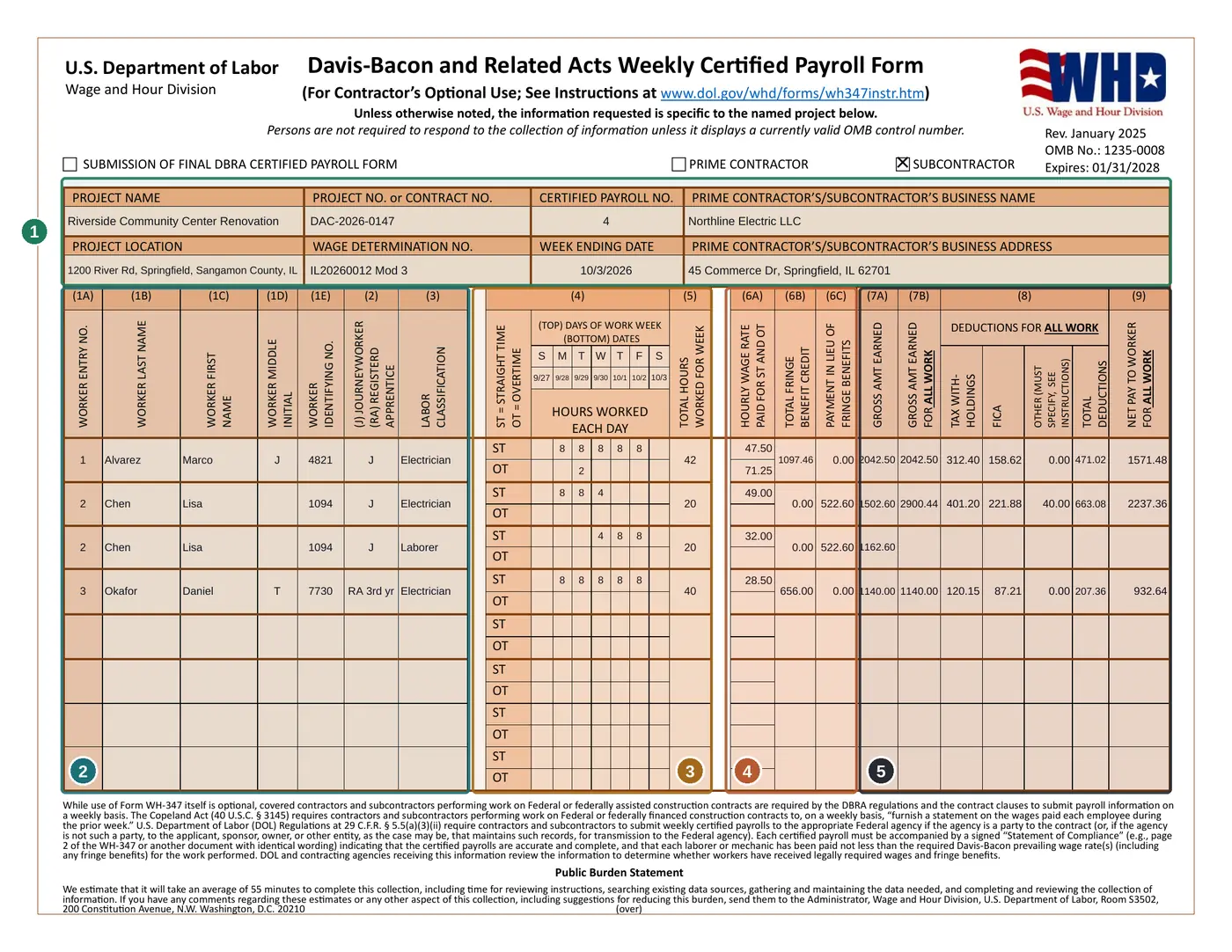
The header
| Box | What to enter |
|---|---|
| Submission of final DBRA certified payroll | Tick it on the payroll for your last week of work on the project. |
| Prime contractor / Subcontractor | Tick the one you are on this project. |
| Project name; project or contract no. | The project you're reporting on, and the project or prime contract number the agency assigned, if there is one. |
| Certified payroll no. | Start at 1 for your first payroll on the project and number each weekly payroll in sequence. |
| Business name and address | Your business's legal name and full address. |
| Project location | The full address, or if there isn't one, a description with at least the county (or counties) and state. |
| Wage determination no. | Every wage determination number and modification number that applied to the work this week. |
| Week ending date | The last day of your workweek for this pay period. |
A week with no work on the project usually needs no payroll under the federal rule, but some agencies want one; the no-work WH-347 guide covers how to number and mark it.
Columns 1A to 3: who and what
- 1A Worker entry no. Number entries from 1. On a second page, the first row is entry 9. A worker who worked in two classifications gets two rows with the same entry number.
- 1B to 1D Name. Last name, first name, middle initial.
- 1E Identifying no. The last four digits of the Social Security number, or another number unique to the worker. Full Social Security numbers must not appear on the form.
- 2 J or RA. J for a journeyworker, RA for a registered apprentice in a program approved by DOL's Office of Apprenticeship (OA) or a State Apprenticeship Agency (SAA). For apprentices, add their level of progression.
- 3 Labor classification. The classification of the work actually done, as named in the wage determination. If there's no classification for the work, contact the contracting officer right away.
Two classifications in one week means a row for each, with the hours worked in each and at least that classification's rate. If you didn't keep an accurate split, DOL's instructions say all hours must be paid at the highest applicable rate, fringe included.
Columns 4 and 5: hours
Above the first row, write the first letter of each day of your workweek and its date underneath. If your week runs Tuesday to Monday, the letters run T W T F S S M.
For each worker, enter hours on this project on the ST (straight time) and OT (overtime) rows. On contracts covered by the Contract Work Hours and Safety Standards Act, hours over 40 in the week are overtime, counting hours worked on and off this project. Column 5 is the total of column 4.
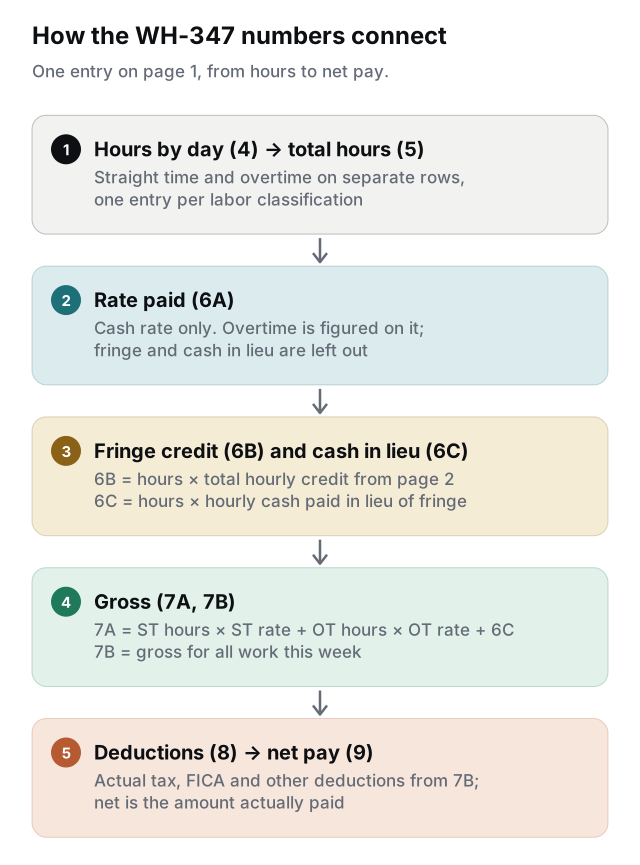
Columns 6A to 7B: rates and gross pay
| Column | What to enter |
|---|---|
| 6A Hourly rate paid | The rate actually paid: straight time on the top row, overtime below. Don't include cash paid in lieu of fringe. |
| 6B Total fringe benefit credit | The week's credit for contributions to (or costs of) bona fide fringe plans: total hours × the worker's total hourly credit on page 2. |
| 6C Payment in lieu of fringe | The cash paid instead of fringe benefits this week: total hours × the hourly amount. |
| 7A Gross amount earned | The worker's gross pay for hours on this project this week. |
| 7B Gross for all work | Gross pay for all work this week, including other projects and non-Davis-Bacon work. |
Overtime is calculated on the cash rate. Under 29 CFR 5.32, fringe contributions and cash paid in lieu of fringe are left out of the rate that overtime is based on, but that rate can't be lower than the wage determination's basic hourly rate.
Columns 8 and 9: deductions and net pay
- 8 Deductions for all work. Tax withholding, FICA and other deductions actually taken from the week's total pay (7B), and their total. If the worker also worked on other jobs, show the actual deductions; don't pro-rate them.
- Other deductions. Describe a single deduction in the remarks on page 2. For more than one, attach an addendum listing each with its amount. Apart from the deductions listed in 29 CFR 3.5, deductions need DOL's approval.
- 9 Net pay for all work. The amount actually paid to the worker for all hours on all projects that week.
Page 2: the Statement of Compliance
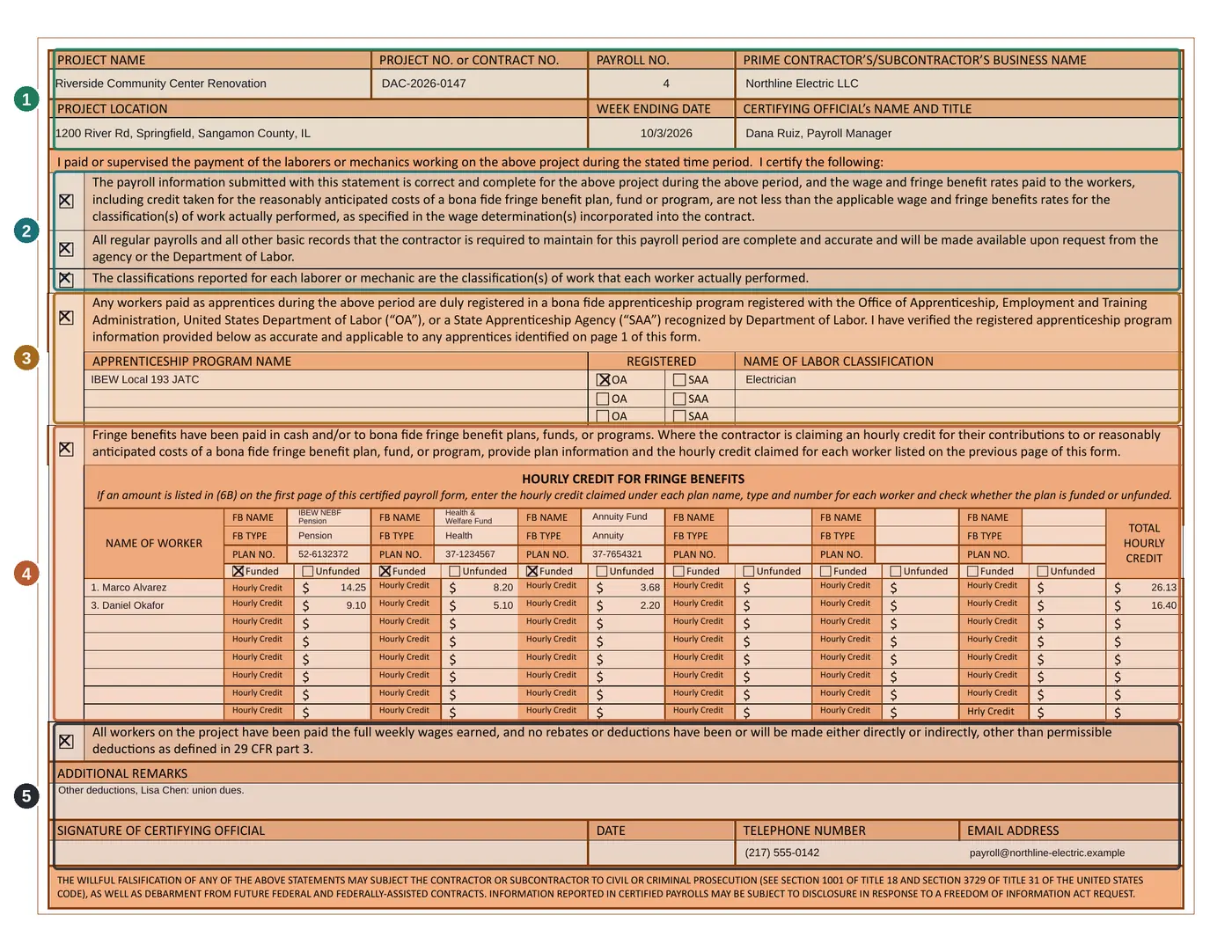
Repeat the project details from page 1, then print the name and title of the certifying official: the contractor, or the agent who paid or supervised paying the workers that week.
| Box | When to tick it |
|---|---|
| 1, 2, 3 and 6 | Every payroll: the information is complete and rates are at least the wage determination's; records are kept; classifications match the work; no improper rebates or deductions. |
| 4 Apprentices | When anyone was paid as an apprentice. List each program, tick OA or SAA and name the classification (an addendum for more than three). If nobody was, leave the box blank and write N/A under the program name. |
| 5 Fringe benefits | When fringe was paid in cash, to plans, or both. If you claim a credit for plans, fill in the table: each plan's name, type, number and funded or unfunded, then each worker's hourly credit per plan and their total. If you only paid cash in lieu, tick the box and leave the table empty. |
Credit for an unfunded plan (benefits you provide directly rather than paying into a fund) needs DOL's prior approval under 29 CFR 5.28. More than six plans means an addendum.
Finish with any remarks, the signature, date, phone and email of the person signing. The statement doesn't need a notary, but it's made under 18 U.S.C. § 1001: false statements can mean a fine, up to five years in prison, or both. A legally valid electronic signature is accepted; a photocopy or scan of a signature isn't.
A worked example
A fictional electrical subcontractor, payroll no. 4 on a community center renovation, week ending Saturday, October 3, 2026. The wage determination requires $47.50 + $26.13 fringe for electricians and $31.85 + $22.40 for laborers.
| Entry | Hours | 6A | 6B | 6C | 7A | 7B | 8 total | 9 |
|---|---|---|---|---|---|---|---|---|
| 1 Alvarez, J, Electrician | 40 ST + 2 OT | $47.50 / $71.25 | $1,097.46 | $2,042.50 | $2,042.50 | $471.02 | $1,571.48 | |
| 2 Chen, J, Electrician | 20 ST | $49.00 | $522.60 | $1,502.60 | $2,900.44 | $663.08 | $2,237.36 | |
| 2 Chen, J, Laborer | 20 ST | $32.00 | $522.60 | $1,162.60 | ||||
| 3 Okafor, RA 3rd yr, Electrician | 40 ST | $28.50 | $656.00 | $1,140.00 | $1,140.00 | $207.36 | $932.64 |
- Alvarez has $26.13 an hour in plan credits (pension, health, annuity): 6B = 42 × $26.13 = $1,097.46. Gross = 40 × $47.50 + 2 × $71.25. Cash plus credit is $73.63, exactly the required rate.
- Chen worked two classifications, so two rows with entry no. 2, and 7B, 8 and 9 on the first only. Cash in lieu of $26.13 an hour gives 6C = 20 × $26.13 = $522.60 per row, included in 7A. 7B is higher because she also worked another job, and the $40 union dues are described in the remarks.
- Okafor is a third-year registered apprentice paid from the program's schedule, so box 4 is ticked and the program is listed with OA. 6B = 40 × $16.40 = $656.00.
The free template includes this payroll on its example tabs.
Mistakes to avoid
- Full Social Security numbers in column 1E.
- Cash in lieu of fringe added to the 6A rate, which also inflates overtime.
- One row for a worker who did two classifications of work.
- Hours over 40 left as straight time on a contract covered by the overtime law.
- 7B left equal to 7A when the worker had other jobs that week, or deductions split between jobs.
- Box 5 left blank when fringe was paid only as cash in lieu.
- An "other" deduction with no description, or a photocopied signature.
Certified Payroll for Google Sheets checks for most of these before it fills in the official PDF.
General information, not legal or payroll advice. The wage determination in your contract and DOL's WH-347 instructions are the authority, and you're responsible for the accuracy of each certified payroll you sign.
Sources
Frequently asked questions
Is Form WH-347 mandatory?+
The form isn't, but weekly certified payroll is. DOL's instructions call the WH-347 optional; the regulations let you submit the same information in any format, with a signed Statement of Compliance worded like page 2. Some agencies and primes require a specific system, so check your contract.
Where do I find the wage determination number?+
In your contract documents. Davis-Bacon wage determinations are published on SAM.gov with a number such as a state code, year and sequence, plus a modification number. Enter every wage determination that applied to work in that week.
What's the difference between 7A and 7B?+
7A is the gross earned on this project that week. 7B is the gross for all work that week, including other projects and non-Davis-Bacon work. If the worker only worked on this project, they're the same.
Who can sign the WH-347?+
The contractor or subcontractor, or their agent who paid or supervised the payment of the workers that week. It needn't be notarized, but false statements fall under 18 U.S.C. § 1001: a fine, up to 5 years in prison, or both.