WH-347 No Work Performed: When to File One and How to Mark It
Short answer
Under the federal rule, you only owe a certified payroll for each week in which covered work is performed, so DOL doesn't require a WH-347 for a week when nobody from your company worked on the project. Many agencies and prime contractors still ask for a "no work performed" payroll so the numbering has no gaps. If yours does, fill in the header with the next payroll number and the week ending date, write "No work performed" on it, and sign page 2.
Does DOL require a WH-347 for a week with no work?
No. The contract clause in 29 CFR 5.5(a)(3)(ii)(A) says the contractor or subcontractor "must submit weekly, for each week in which any DBA- or Related Acts-covered work is performed, certified payrolls." A week in which none of your workers did covered work on the project isn't one of those weeks, and DOL's WH-347 instructions don't mention no-work weeks.
That's the federal floor, not the whole answer. The same clause makes the prime contractor "responsible for the submission of all certified payrolls by all subcontractors," and agencies can hold back payments when required records aren't submitted. From the outside, a skipped week looks like a late payroll, so many agencies and primes add their own no-work rule.
Who asks for a no-work payroll anyway
The rules differ by agency and contract. Published examples show the range:
| Who | What they say about no-work weeks |
|---|---|
| Federal rule (29 CFR 5.5) | Payrolls are due for each week in which covered work is performed. Nothing about no-work weeks. |
| HUD (Handbook 1344.1, chapter 4) | Not required for weeks with no work on the site, "provided that the payroll reports are numbered sequentially or that the employer has provided written notice that its work on the project has been suspended." |
| Pennsylvania Housing Finance Agency | Required: a payroll with "NO WORK PERFORMED" written across it, or its separate "No Work" Report Form. |
| California DIR (state public works) | Its electronic system has a Statement of Non-Performance for a period with no work (see below). |
| Your prime contractor | Whatever your subcontract says. Many primes want one so their own file for the agency has no gaps. |
Check your contract and the agency's payroll instructions. If they're silent, ask the labor compliance officer or the prime in writing.
How to fill in a no-work WH-347
You can use the blank DOL WH-347 PDF or our free WH-347 template. Unless the agency gives you its own wording, a no-work payroll looks like this:
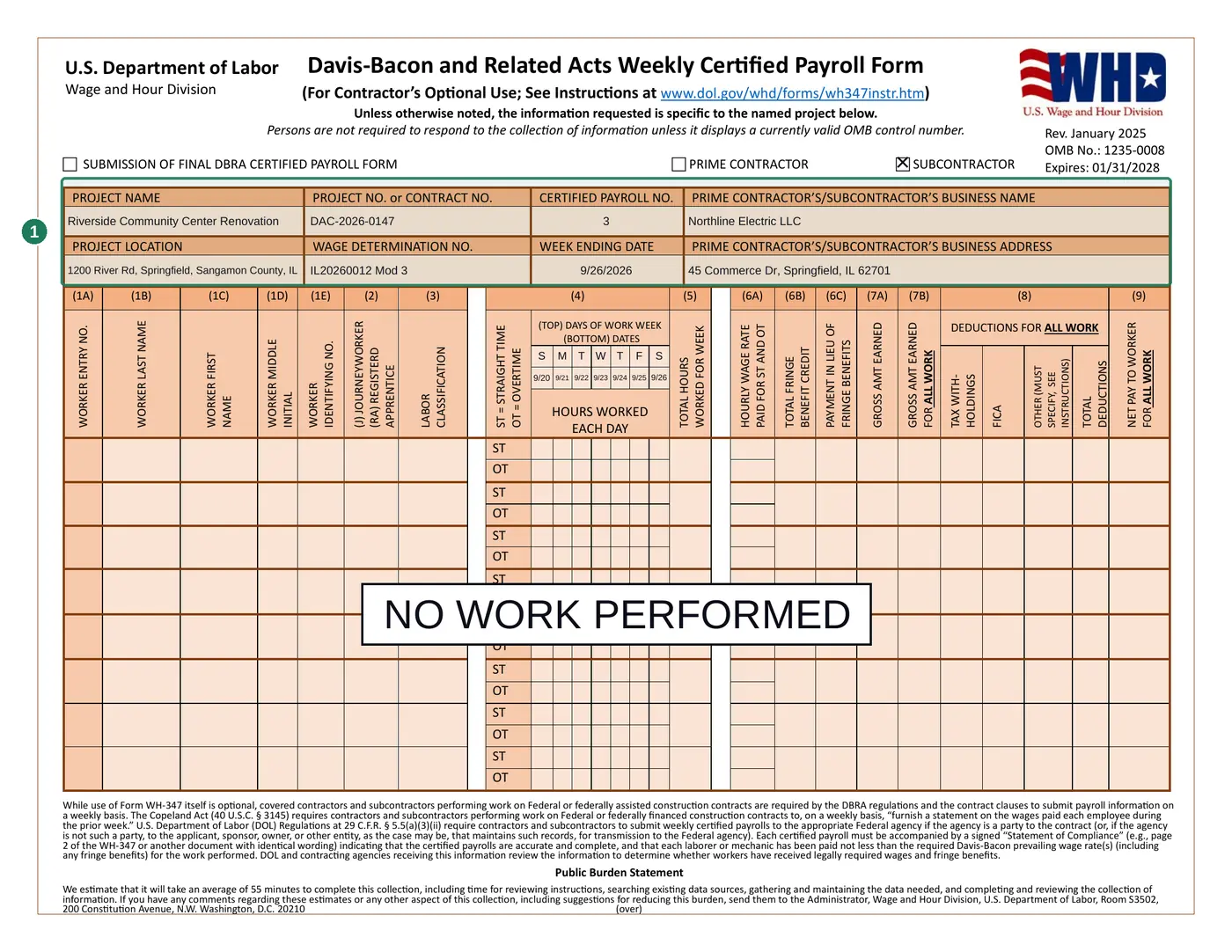
- Header on page 1: project, business and wage determination details, as on every other week.
- Certified payroll no.: the next number in your sequence for this project.
- Week ending date: the last day of the workweek with no work.
- Worker rows: leave them blank and write "NO WORK PERFORMED" across them. Don't list workers with zero hours.
- Remarks on page 2: "No work performed on this project during this week," plus a short reason (weather, waiting on another trade) if the agency asks.
- Sign page 2 by hand or with a legally valid electronic signature, the same as any other payroll, and send it wherever your regular payrolls go.

Leave the "final" box unticked. The box-by-box WH-347 guide covers each header box. If the agency has instructions for the statement boxes on a no-work payroll, follow them.
Payroll numbers and no-work weeks
DOL's instructions say to give each weekly certified payroll you submit for a project a number, beginning with "1." A no-work payroll is a submission, so it takes the next number like any other. That's the point of it: payrolls 1 to 5 with no gaps tell the reviewer nothing is missing.
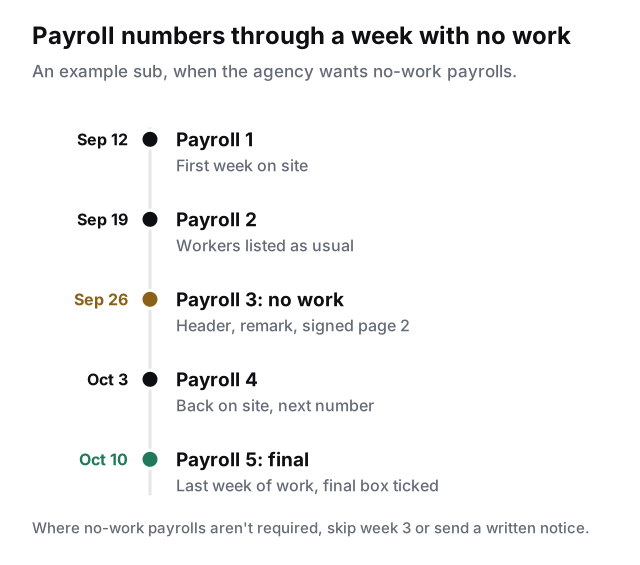
If your agency doesn't want no-work payrolls, don't burn a number on the empty week: payroll 3 is simply the next week you worked. HUD treats unbroken numbering as one of the ways to show a skipped week wasn't a missing payroll. Number each project separately, starting from 1.
A no-work letter or notice instead
For several weeks off a job, a letter is easier than a stack of empty payrolls. HUD accepts written notice that your work has been suspended, and some agencies have their own "No Work" form. A letter usually covers:
- Your company name, the project name and the project or contract number.
- The week ending dates (or the date range) when none of your workers were on the site.
- A statement that none of your laborers or mechanics worked on the project then.
- The signature, name and title of the person who signs your payrolls.
Only use a letter where the agency or prime accepts one.
California: the Statement of Non-Performance
California public works have their own certified payroll system, separate from the federal WH-347. The Department of Industrial Relations says contractors and subcontractors, with a few listed exceptions, must submit certified payroll records to the Labor Commissioner through its website, at least monthly or more often if the contract requires it.
DIR's electronic certified payroll (eCPR) system has a Non-Performance checkbox. Its user guide says employee and payroll information "are not required for a statement of non-performance": you enter the week ending date, sign and submit. If you filed payroll for a period with no work by mistake, DIR's FAQ says a Statement of Non-Performance for the same period "will take precedence over the record submitted in error." Whether your awarding body expects one for every gap week is a question for them.
Before you start and after you finish
- Before your first week on site: HUD says payroll reports begin "with the first week such employer performs work on the site of the work." Weeks before you mobilize usually need nothing.
- Your last week of work: tick the box for the final certified payroll on the week you finish. Don't send a no-work payroll marked final.
- Keep copies: payroll records must be kept for at least 3 years after all the work on the prime contract is completed. Keep no-work payrolls and letters with the rest.
Davis-Bacon basics: what the WH-347 is for
The Davis-Bacon Act applies to federally funded or assisted contracts over $2,000 for the construction, alteration or repair, including painting and decorating, of public buildings or public works. Contractors and subcontractors must pay laborers and mechanics at least the locally prevailing wages and fringe benefits in the contract's wage determination. Related Acts extend this to projects assisted through federal grants, loans, loan guarantees and insurance.
The WH-347 is DOL's optional form for the weekly certified payroll that proves it. You can use any format that carries the same information and a signed Statement of Compliance.
Who's exempt: under 29 CFR 5.2, "laborers and mechanics" are workers whose duties are manual or physical. Workers whose duties are primarily administrative, executive or clerical aren't covered, nor are bona fide executive, administrative or professional employees. A foreperson who spends more than 20% of a workweek on trade work is covered for that time.
How to tell a job is prevailing wage: the contract or subcontract includes the Davis-Bacon labor standards clauses and a wage determination. If there's federal money in the project and you can't find either, ask before you start.
Let the tool do it
Certified Payroll for Google Sheets has a "No work performed this week" option. Tick it and the WH-347 PDF comes out with your project header, the next payroll number, "NO WORK PERFORMED" across the empty worker rows and "No work performed on this project during this week." in the remarks, and the week is logged as a no-work payroll. It doesn't write no-work letters or submit to California's eCPR system.
General information, not legal or payroll advice. Your contract, the agency's instructions and the regulations are the authority, and requirements for no-work weeks vary by agency. For a specific situation, ask the contracting agency's labor compliance officer or a construction attorney.
Sources
- 29 CFR 5.5: contract clauses, including weekly certified payrolls
- DOL Wage and Hour Division: instructions for completing Form WH-347
- HUD Handbook 1344.1 REV-3, chapter 4: payroll reporting
- Pennsylvania Housing Finance Agency: certified payroll report form requirements
- California DIR: frequently asked questions on public works
- California DIR: eCPR application user guide
- DOL: Davis-Bacon and Related Acts
Frequently asked questions
What is the WH-347?+
It's the Department of Labor's optional form for the weekly certified payroll that contractors and subcontractors on federal and federally assisted construction jobs must submit. Page 1 is the payroll; page 2 is the signed Statement of Compliance.
Do I have to submit a WH-347 if no work was performed?+
Not under the federal regulation, which requires a payroll for each week in which covered work is performed. Your contract, the agency or your prime contractor can still require a no-work payroll or letter, and many do, so check before you skip a week.
What is the Davis-Bacon Act?+
A federal law that requires contractors and subcontractors on federally funded or assisted contracts over $2,000 for building, altering or repairing public buildings or public works to pay laborers and mechanics at least the locally prevailing wages and fringe benefits.
Who is exempt from Davis-Bacon wages?+
Workers whose duties are mainly administrative, executive or clerical rather than manual, and people employed in a bona fide executive, administrative or professional capacity under 29 CFR part 541. A foreperson who spends more than 20% of a workweek on trade work is covered for that time.
How can I tell if a job is prevailing wage?+
A federally covered job's contract includes the Davis-Bacon labor standards clauses and a wage determination listing classifications and rates. If you're not sure, ask the contracting agency or the prime contractor before you bid or start work.