What Is Certified Payroll? Meaning, Who Needs It and How It Works
Short answer
Certified payroll is a weekly payroll report that contractors and subcontractors on prevailing wage construction jobs submit to the agency or owner paying for the work. It lists each worker's job classification, hours, pay rate, deductions and wages for the week. It's "certified" because the employer signs a Statement of Compliance swearing the payroll is correct and the required rates were paid. On federal Davis-Bacon jobs, DOL's optional Form WH-347 is the standard format.
What certified payroll means
Most of the meaning is in the word "certified." The payroll itself is ordinary information: who worked, what trade they worked in, how many hours, at what rate, and what they took home. What makes it certified is the signed statement attached to it. Under 29 CFR 5.5, that Statement of Compliance says the payroll is complete and correct, every worker got their full weekly wages without improper deductions, and each was paid at least the rates the contract requires.
Those rates come from the wage determination in your contract: a basic hourly rate plus a fringe benefit rate for each classification, such as electrician or laborer. That rate is the prevailing wage, and certified payroll is the weekly proof you paid it (see certified payroll vs prevailing wage).
Certified payroll vs regular payroll
Certified payroll doesn't replace your normal payroll. It's an extra report built from the same data, for one covered project at a time.
| Regular payroll | Certified payroll | |
|---|---|---|
| Purpose | Pay workers and handle taxes | Prove a covered job paid the required rates |
| Scope | Your whole company | One project, one week |
| Pay rates | What you agree with the worker | At least the wage determination's basic rate plus fringe, by classification |
| Who sees it | You, your workers and tax agencies | The contracting agency or owner, through the prime contractor |
| Signature | None required | A signed Statement of Compliance, subject to 18 U.S.C. § 1001 |
| How often | Your pay schedule | Weekly on federal jobs; state rules vary |
Which jobs need certified payroll
On the federal side, the trigger is the Davis-Bacon Act. Two tests: the contract is over $2,000 and paid for or assisted with federal money, and the work is building, altering or repairing a public building or public work (DOL counts painting and decorating). The Related Acts carry the same rules to jobs where a federal agency helps through a grant, loan, loan guarantee or insurance. So a city project built partly with federal grant money can be covered even though the city, not a federal agency, signs your contract.
The rules protect laborers and mechanics doing the trade work. A covered contract includes the Davis-Bacon labor clauses and a wage determination; if you're unsure, ask the contracting officer before the first week. Many states and cities also have their own prevailing wage laws, so a job with no federal money can still need certified payroll.
What goes on a certified payroll report
29 CFR 5.5 lists what the weekly payroll must show for each worker: an individual identifying number (such as the last four digits of their Social Security number, never the full number), classification, hourly rates, daily and weekly hours, deductions and wages paid. On the WH-347 that's page 1, one entry per worker and classification.
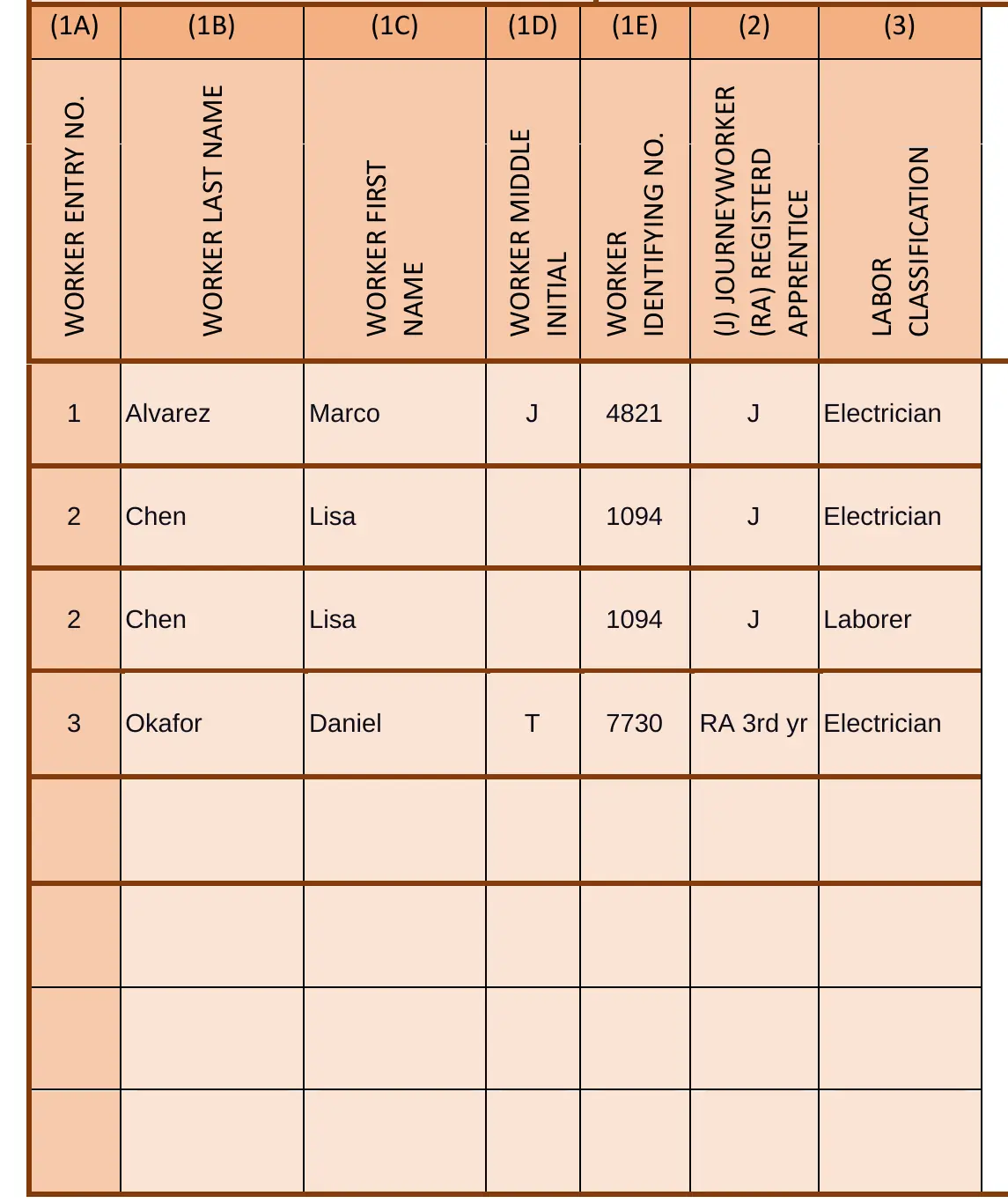
Page 2 holds the Statement of Compliance, apprenticeship and fringe plan details, and the signature of the person who paid or supervised paying the workers. DOL accepts a legally valid electronic signature, but not a photocopied or scanned one.

For what goes in each box, from the wage determination number to net pay, see how to fill out Form WH-347.
How certified payroll works each week
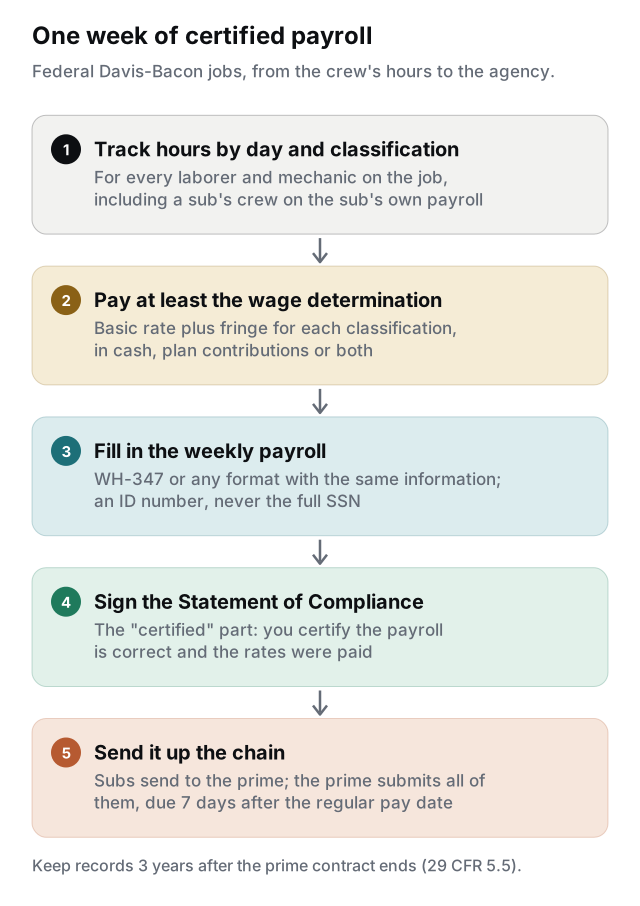
A payroll is due for every week with covered work, within 7 days after that period's regular pay date, according to DOL's resource book. It goes to the federal agency if it's a party to the contract; otherwise to the applicant, sponsor or owner, which passes it on. Keep the records for at least 3 years after all work on the prime contract is done. Some agencies want a payroll even for weeks with nobody on site; see the no-work WH-347.
Subcontractors and 1099 workers
Every employer with laborers or mechanics on the job prepares its own certified payroll. A subcontractor's crew doesn't go on the prime's payroll; the sub signs its own and sends it up. The prime then submits all of them, and 29 CFR 5.5 makes the prime responsible for compliance by every sub and lower-tier sub.
Calling someone a subcontractor doesn't take them off the report. The regulation requires the prevailing wage "regardless of any contractual relationship which may be alleged to exist" between the contractor and the worker. An individual tradesperson you pay on a 1099 to hang drywall on a covered job is still owed the classification's rate, and their hours and pay still have to be recorded.
State versions: California, New York, Illinois
State prevailing wage laws come with their own reporting systems, and they often replace the WH-347 rather than add to it. A few common ones, as of this guide's update date:
| Where | How certified payroll is submitted |
|---|---|
| California | Prevailing wage applies to public works over $1,000. Certified payroll records go electronically to the Labor Commissioner through DIR at least monthly. Projects up to $25,000 (construction) or $15,000 (maintenance) are exempt from electronic reporting, but records must still be kept. |
| New York State | Contractors and subs on Article 8 projects submit through NYSDOL's Certified Payroll system, at least every 30 days, using a NY.gov account. |
| New York City | City public work contracts solicited on or after December 31, 2025 file through the city's own online certified payroll database. The Comptroller's Certified Payroll Report covers one week on one project and is signed by an officer or principal of the employer, who acknowledges that falsifying it is a punishable offense. |
| Illinois | Prevailing wage contractors file through the Illinois Department of Labor's Certified Transcript of Payroll Portal. |
If a job has both federal money and state coverage, ask the awarding body which reporting system it wants.
What happens if it's wrong or late
- Withheld payments. The agency can withhold contract funds to cover wages owed, and after written notice can suspend payments to a contractor that doesn't submit its payrolls.
- Back wages. Underpaid workers are owed the difference.
- Termination and debarment. A breach of the labor clauses can be grounds for terminating the contract. Under 29 CFR 5.12, a contractor found to have disregarded its obligations to workers can be barred from federal contracts for 3 years.
- Prosecution. Falsifying the certification can lead to civil or criminal action under 18 U.S.C. § 1001 and the False Claims Act (31 U.S.C. § 3729).
Can QuickBooks do certified payroll?
Partly. Intuit documents a Certified Payroll Report for QuickBooks Desktop Payroll Enhanced and Assisted, under Reports › Employees & Payroll › More Payroll Reports in Excel. It needs a full version of Excel and hourly payroll items for each work classification, and Intuit says it can be used to fill out the WH-347. That article covers Desktop only, so QuickBooks Online users should check with Intuit.
If your payroll runs somewhere else, you can still produce certified payroll from its numbers. For one project, the free WH-347 template does the arithmetic in a spreadsheet. For several projects a week, Certified Payroll for Google Sheets checks each worker's pay against the wage determination and fills in the official WH-347 PDF. It doesn't run paychecks, calculate taxes or submit to state systems like California's.
General information, not legal or payroll advice. Your contract, its wage determination and the agency's instructions are the authority, and state and city rules change. For a specific situation, ask the agency's labor compliance officer or a construction attorney.
Sources
- 29 CFR 5.5: contract clauses, payrolls and basic records
- DOL Wage and Hour Division: instructions for completing Form WH-347
- DOL Prevailing Wage Resource Book: Davis-Bacon compliance principles
- DOL Wage and Hour Division: construction contracts (Davis-Bacon and Related Acts)
- California DIR: public works registration and reporting FAQ
- New York State DOL: electronic certified payroll submission
- 29 CFR 5.12: debarment proceedings
- NYC: online database for certified payroll
- NYC Comptroller: Certified Payroll Report form
- Illinois Department of Labor: Certified Transcript of Payroll
- PayrollOrg: certification FAQ
- Intuit: prevailing wages and certified payroll reports in QuickBooks Desktop Payroll
Frequently asked questions
What is the difference between certified payroll and regular payroll?+
Regular payroll is how you pay your workers and withhold taxes. Certified payroll is a separate report for one covered project and one week, showing what you paid each worker by classification, signed under penalty of law to confirm you paid at least the required prevailing wage rates.
Can QuickBooks do certified payroll?+
QuickBooks Desktop Payroll Enhanced and Assisted have a Certified Payroll Report, built in Excel, that Intuit says can be used to fill out the WH-347. Intuit's help article covers QuickBooks Desktop only, so if you use QuickBooks Online, confirm with Intuit or fill in the WH-347 another way.
Do subcontractors count as payroll?+
A subcontractor's crew goes on the subcontractor's own certified payroll, not yours, but the prime is responsible for collecting and submitting every sub's payrolls. An individual laborer or mechanic you pay on a 1099 is still owed the prevailing wage regardless of the contract label, and their hours and pay still have to be recorded.
How do I get my payroll certification?+
Certified payroll isn't a credential: it's the weekly report itself, signed by the contractor or subcontractor, or their agent who paid or supervised paying the workers. If you mean a credential for payroll staff, PayrollOrg offers the Fundamental Payroll Certification (FPC) and the Certified Payroll Professional (CPP) exams, which are optional.
Is the WH-347 form required?+
No. DOL calls Form WH-347 optional: you can report the same information in another format with a signed Statement of Compliance. Your contract, or a state or city system, may require a specific format, so check before your first week.