Davis-Bacon Overtime Rules: 40 Hours, CWHSSA and the Fringe
Short answer
The Davis-Bacon Act sets wage rates, not overtime. Overtime on a Davis-Bacon job comes from the Contract Work Hours and Safety Standards Act (CWHSSA) on contracts over $100,000, and from the FLSA: at least 1.5 times the basic rate for hours over 40 in a workweek, with no federal daily overtime. The premium is figured on the cash rate, never below the wage determination's basic rate, and fringe is paid for every hour but not multiplied.
Which law requires the overtime
The Davis-Bacon Act only sets minimum hourly pay. DOL names two federal laws that require overtime on government contracts:
- CWHSSA (40 U.S.C. 3701–3702) covers laborers and mechanics, including guards and watchpersons, on contracts over $100,000, including jobs paid for partly with federal grants or loans. For direct federal contracts under the Federal Acquisition Regulation, FAR 22.305 leaves the overtime clause out of contracts valued at or below $200,000 as of this guide's update date (DOL's training slides still show $150,000). DOL calls CWHSSA self-executing: it applies even when the contract doesn't mention it.
- The FLSA can require overtime on Davis-Bacon contracts that CWHSSA doesn't cover, such as smaller jobs, and it can apply alongside CWHSSA on the ones it does.
Is it over 40 hours a week or 8 a day?
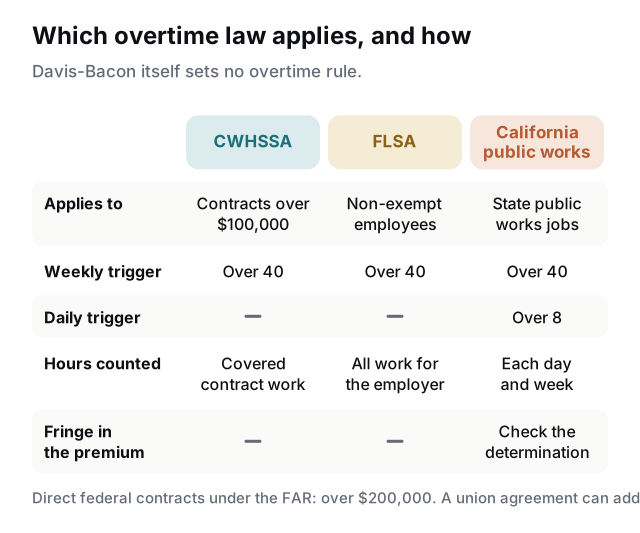
Federally, it's 40 a week: the statute covers "all hours worked in excess of 40 hours in the workweek". CWHSSA's old 8-hour daily rule was repealed for hours worked from January 1, 1986. So four 10-hour days owe no federal overtime, and neither law requires a premium for weekends or holidays. Daily rules can still come from elsewhere:
- California public works (state prevailing wage jobs): work past 8 hours a day or 40 a week must be paid as overtime, generally at time and a half, under 8 CCR 16100. Check the state determination for each craft's overtime rate.
- Texas: no daily overtime. The Texas Workforce Commission says neither Texas nor federal law requires it.
- Union agreements and employment contracts: DOL's memo on the repeal notes they may still require daily overtime. That's a contract duty, not a Davis-Bacon one.
Which hours count toward 40
CWHSSA counts all time on covered contracts, on site and off (tool yard time and travel from the shop to the site included), and leaves out private work. The FLSA counts every hour worked for the employer that week. A carpenter with 30 hours on a Davis-Bacon school and 15 on a private house is owed nothing under CWHSSA, but is owed FLSA overtime for 5 hours. DOL's WH-347 instructions say that on CWHSSA contracts, project hours past 40 total in the week, counting hours on and off the site of the covered contract, go on the form as overtime. Paid holidays and leave aren't hours worked, so they don't count.
The overtime rate and the fringe
CWHSSA requires at least 1.5 times the basic rate of pay, which DOL defines as the straight-time hourly cash rate. Under 29 CFR 5.32 and DOL's guidance:
| Pay item | In the overtime base? |
|---|---|
| Cash hourly rate actually paid | Yes, and the base is never lower than the wage determination's basic rate |
| Contributions to bona fide fringe plans | No: paid for every hour at the straight amount |
| Cash paid in lieu of fringe | No, as long as it really is paid in place of benefits |
| Cash that is just part of the normal wage | Yes, even if you call it fringe |
| Employee contributions, such as 401(k) deferrals | Yes: they come out of the worker's wage, which stays in the base |
One 44-hour week, paid three ways
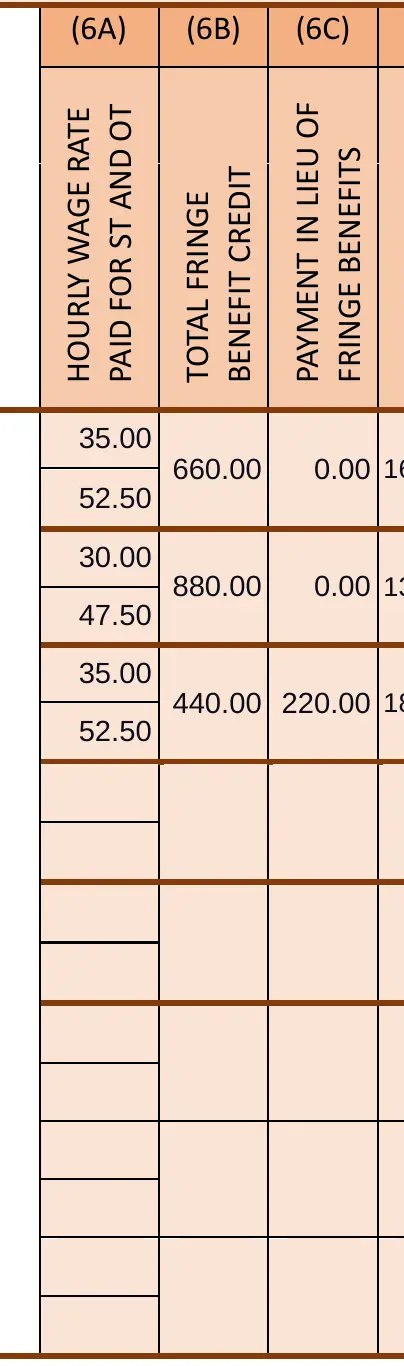
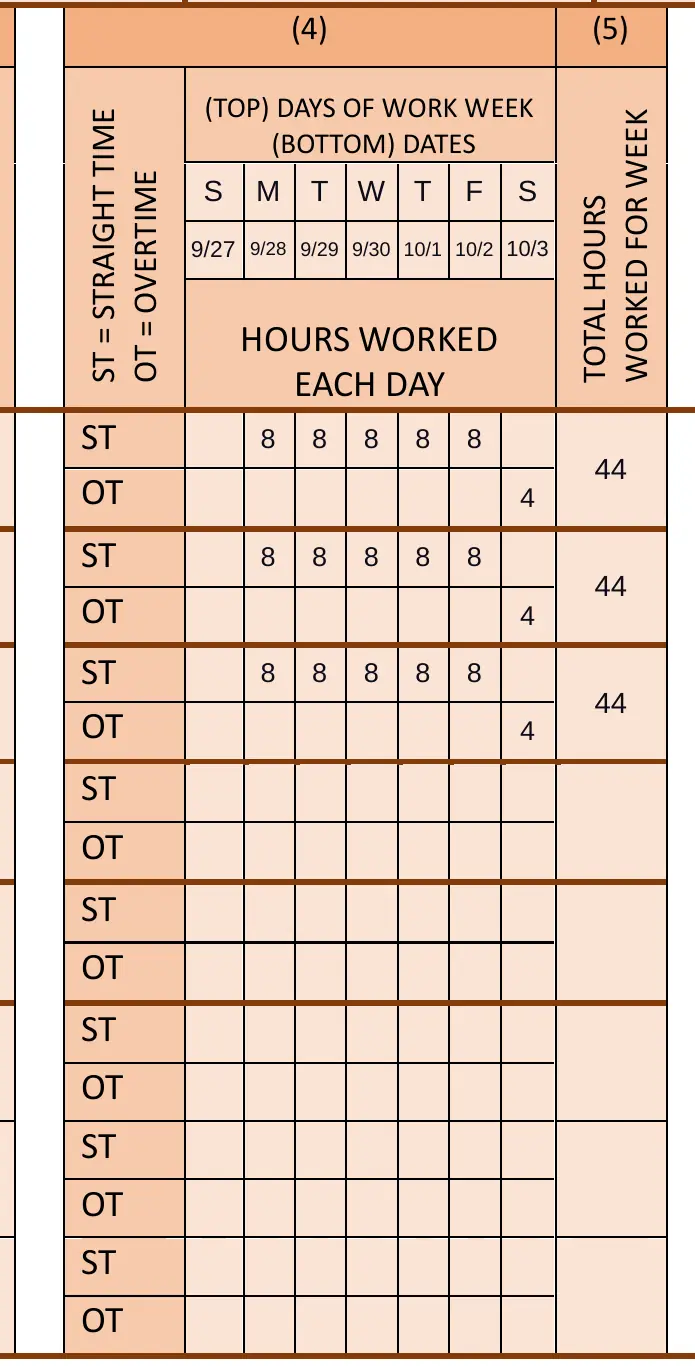
DOL's example: an electrician at $35.00 basic plus $15.00 fringe works 44 hours. All three ways of paying total $2,270.00:
- $35.00 cash plus $15.00 to plans. 44 × $35.00 = $1,540.00, 44 × $15.00 = $660.00 in benefits, and 4 × 0.5 × $35.00 = $70.00 premium. The overtime cash rate is $52.50.
- $30.00 cash plus $20.00 to plans. 44 × $30.00 = $1,320.00, $880.00 in benefits, and the same $70.00 premium, because it's figured on the $35.00 basic rate, not $30.00. The overtime cash rate is $47.50, not $45.00.
- $35.00 cash, $5.00 in lieu, $10.00 to plans. $1,540.00 + $220.00 + $440.00 + $70.00. The cash in lieu goes on every hour but stays out of the premium.
The prevailing wage calculator runs this test for one worker.
Two classifications in one week
When a worker does two kinds of work at different rates, DOL allows two methods. DOL's example: 30 hours as a painter at $33.00 and 18 as an electrician at $35.00, 48 hours in all.
- Weighted average. Straight-time pay without fringe is $990.00 + $630.00 = $1,620.00. Divided by 48 hours, the regular rate is $33.75, so the premium is 8 × $16.88 = $135.04.
- Rate in effect. If the worker agreed before doing the work, you can pay 1.5 times the rate for the work done during the overtime hours. If those 8 hours were electrical work on a Saturday, the premium is 8 × $17.50 = $140.00.
The 2026 FLSA overtime rule
This is the "new overtime rule" in the news. A federal court in Texas vacated DOL's 2024 rule in November 2024, and on May 15, 2026 DOL formally removed it, restoring the 2019 salary levels: $684 a week for the executive, administrative and professional exemptions and $107,432 a year for highly compensated employees.
The salary test decides which office and supervisory staff are exempt. Under 29 CFR 5.2, a foreperson who spends more than 20% of a workweek on tools and doesn't meet the part 541 exemption is a laborer or mechanic for that time, owed prevailing wages and overtime.
Liquidated damages and withholding
Missing CWHSSA overtime costs more than the back pay. Under the contract clauses in 29 CFR 5.5(b):
- you owe the unpaid wages plus interest from the date of underpayment;
- you owe liquidated damages for each worker, for each calendar day they worked over 40 hours without proper overtime. The clause sets $33 a day, and DOL's penalty table shows $33, unchanged for 2026;
- the agency can withhold contract payments to cover both, including from other contracts held by the same prime;
- the prime is responsible for its subcontractors' compliance.
Under the FLSA, liquidated damages equal the unpaid overtime. Keep records of the daily and weekly hours actually worked for 3 years after the contract work is completed.
Recording overtime on the WH-347
On page 1, enter each day's hours on the project in column 4, straight time on the ST row and overtime on the OT row. The overtime cash rate goes on the bottom row of 6A, without cash in lieu. Fringe credit (6B) and cash in lieu (6C) cover all hours, overtime included, at the straight amount.
The WH-347 guide covers every other box. Certified Payroll for Google Sheets warns about a worker over 40 project hours with no overtime, or an overtime rate below what's owed, before it fills in the official PDF. Hours on private jobs and state daily overtime are still yours to account for.
General information, not legal or payroll advice. Your contract's labor clauses, the wage determination, 29 CFR part 5 and DOL's Wage and Hour Division are the authority. For a specific situation, ask WHD, the contracting agency or a construction attorney.
Sources
- 40 U.S.C. 3702: CWHSSA standard workweek and overtime
- 29 CFR 5.32: overtime payments and fringe benefits
- 29 CFR 5.5(b): CWHSSA contract clauses, liquidated damages and withholding
- DOL Prevailing Wage Resource Book: CWHSSA and overtime pay on government contracts
- DOL Wage and Hour Division: CWHSSA and FLSA, overtime and government contracts (seminar slides)
- DOL All Agency Memorandum 143: repeal of daily overtime (1985)
- Proskauer: DOL makes it official, the 2024 overtime rule is gone
Frequently asked questions
Is overtime technically over 40 hours?+
Under federal law, yes. CWHSSA and the FLSA both require time and a half for hours over 40 in a workweek. Neither counts hours per day, so a 10-hour day in a 40-hour week owes no federal overtime.
Does Davis-Bacon require overtime after 8 hours in a day?+
No. CWHSSA's 8-hour daily rule was repealed for hours worked from January 1, 1986. Daily overtime can still be owed under state law, such as California's public works rules, or under a union agreement or employment contract.
Is over 8 hours in a day overtime in Texas?+
No. The Texas Workforce Commission says neither Texas nor federal law requires daily overtime. Overtime is owed for hours over 40 in a seven-day workweek, on Davis-Bacon jobs and private jobs alike.
What is the new FLSA overtime pay rule for 2026?+
On May 15, 2026, DOL formally removed the vacated 2024 rule and restored the 2019 salary level: $684 a week for the executive, administrative and professional exemptions. That salary test is for office and supervisory staff; it doesn't change overtime for laborers and mechanics on Davis-Bacon jobs.
Are fringe benefits paid at time and a half on overtime?+
No. The full fringe amount is owed for every overtime hour, but only once. Under 29 CFR 5.32, plan contributions and cash paid in lieu of fringe are left out of the rate the half-time premium is figured on.